
SOP:Good Standing vs. At-Risk Staff
Purpose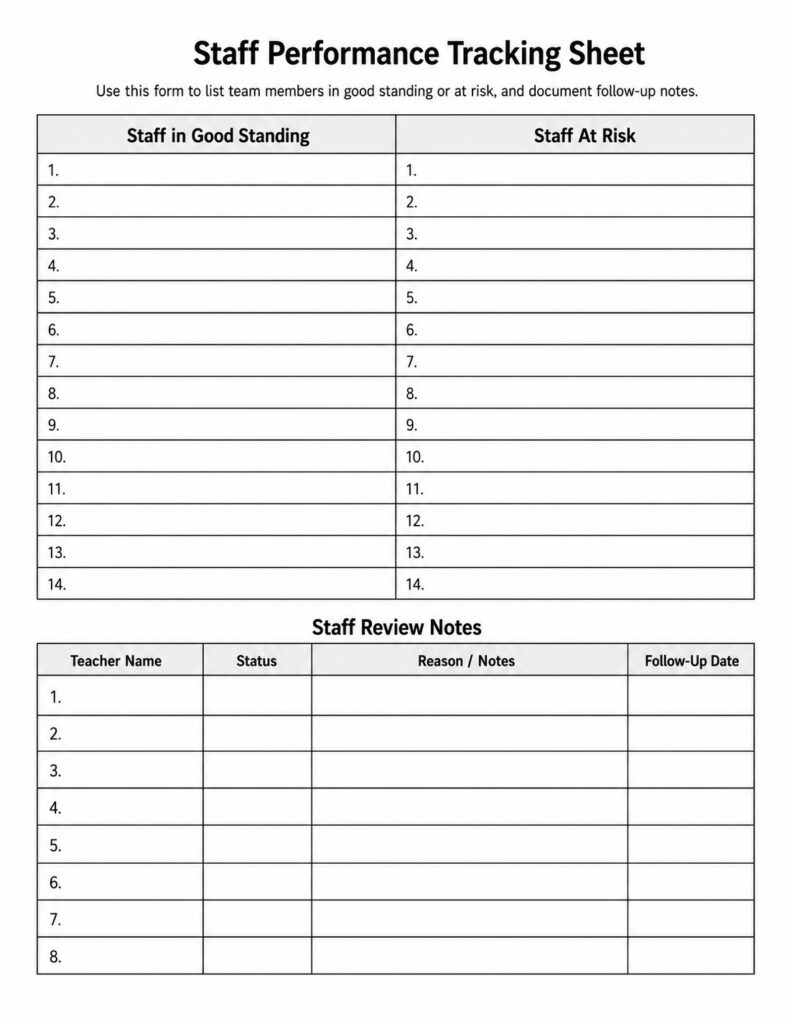
This SOP helps leadership identify whether a staff member is performing in good standing or is considered at risk. The goal is to create consistency, support teachers early, protect children’s safety, and maintain high-quality operations.
This SOP should be used by directors, assistant directors, and leadership team members when observing, coaching, documenting, and making staffing decisions.
2. Staff Performance Categories
Staff performance will be reviewed in two main categories:
A. Good Standing
A staff member is in good standing when they consistently meet the expectations of the school, follow procedures, support children positively, and contribute to a safe and professional environment.
B. At Risk
A staff member is considered at risk when there are repeated concerns, safety issues, poor attitude, lack of reliability, failure to follow procedures, or behaviors that may negatively affect children, families, coworkers, or school operations.
3. Good Standing Staff Criteria
A staff member is considered in good standing when they consistently demonstrate the following:
Attendance and Reliability
- Arrives on time.
- Follows assigned schedule.
- Gives proper notice when absent.
- Returns from breaks on time.
- Is dependable during transitions, opening, and closing.
- Does not create repeated staffing issues.
Classroom Supervision
- Maintains ratio at all times.
- Knows how many children are in their care.
- Completes name-to-face checks.
- Keeps children supervised indoors and outdoors.
- Does not leave children unattended.
- Communicates before leaving the classroom.
Child Interaction
- Speaks kindly to children.
- Uses positive guidance.
- Shows patience and warmth.
- Supports children’s emotional needs.
- Redirects behavior appropriately.
- Creates a safe and loving environment.
Curriculum Implementation
- Reviews lesson plans.
- Prepares materials.
- Implements daily activities.
- Participates in weekly projects.
- Updates classroom boards.
- Displays children’s work.
- Keeps children engaged in learning.
Classroom Environment
- Keeps the classroom clean and organized.
- Maintains learning centers.
- Sanitizes tables, toys, and high-touch areas.
- Removes unsafe materials.
- Keeps supplies prepared.
- Creates a welcoming classroom.
Teamwork
- Communicates respectfully with coworkers.
- Helps during transitions.
- Accepts feedback.
- Supports school needs.
- Maintains a positive attitude.
- Avoids gossip and conflict.
Parent Communication
- Greets families warmly.
- Shares appropriate daily updates.
- Maintains confidentiality.
- Refers serious concerns to leadership.
- Communicates professionally.
Compliance and Safety
- Follows licensing rules.
- Completes required training.
- Follows diapering, toileting, meal, nap, and playground procedures.
- Reports incidents immediately.
- Completes documentation accurately.
4. At-Risk Staff Criteria
A staff member may be considered at risk if leadership observes repeated or serious concerns in any of the following areas:
Attendance Concerns
- Frequent tardiness.
- Repeated call-outs.
- Leaving early without proper approval.
- Not returning from break on time.
- Creating coverage problems.
- No-call/no-show.
Supervision Concerns
- Not knowing child count.
- Leaving children unattended.
- Being distracted while supervising.
- Using phone during supervision.
- Failing to maintain ratio.
- Unsafe playground supervision.
- Not completing name-to-face checks.
Child Interaction Concerns
- Speaking harshly to children.
- Showing impatience or frustration.
- Ignoring crying or upset children.
- Using inappropriate discipline.
- Failing to comfort or redirect children.
- Not engaging with children.
Curriculum Concerns
- Not following lesson plans.
- No preparation for activities.
- Children not engaged.
- Classroom boards not updated.
- No evidence of weekly project.
- Refusing or avoiding curriculum implementation.
Classroom Management Concerns
- Chaotic classroom environment.
- Poor transitions.
- Children running without redirection.
- Unsafe classroom setup.
- Repeated cleanliness issues.
- Lack of structure or routine.
Professionalism Concerns
- Negative attitude.
- Gossiping.
- Arguing with coworkers.
- Being disrespectful to leadership.
- Not accepting feedback.
- Speaking negatively in front of children or families.
- Personal phone use during work time.
Parent Communication Concerns
- Rude or cold communication.
- Sharing confidential information.
- Failing to communicate important child updates.
- Giving parents incorrect information.
- Discussing school issues with families inappropriately.
Documentation Concerns
- Incomplete incident reports.
- Missing attendance updates.
- Incorrect diapering or meal logs.
- Failure to document parent communication.
- Not reporting concerns to leadership.
5. Immediate Red Flag Behaviors
Some behaviors require immediate leadership action and may move the employee directly into an at-risk status or disciplinary process.
These include:
- Leaving a child unattended.
- Being out of ratio.
- Harsh treatment of a child.
- Inappropriate discipline.
- Sleeping while supervising children.
- Unsafe handling of a child.
- Falsifying records.
- Sharing confidential information.
- Allowing unauthorized people into the building.
- Refusing to follow safety instructions.
- No-call/no-show.
- Serious disrespect toward families, children, or staff.
6. Staff Observation Procedure
Leadership should observe staff regularly using the same standard.
Step 1: Observe
The director or assistant director observes the staff member during:
- Arrival
- Classroom routine
- Transitions
- Meals
- Nap
- Outdoor play
- Curriculum time
- Parent pick-up
- Closing
Step 2: Identify Status
After observation, leadership determines whether the staff member is:
- In good standing
- Needs coaching
- At risk
- Immediate concern
Step 3: Document
Leadership should document:
- Date
- Time
- Classroom
- What was observed
- Strengths
- Concerns
- Coaching provided
- Next steps
Step 4: Follow Up
Leadership should follow up within a reasonable timeframe to confirm improvement.
7. Good Standing Staff Recognition
Staff in good standing should be recognized and encouraged.
Recognition may include:
- Verbal praise
- Positive note
- Staff shout-out
- Leadership group recognition
- Opportunity to mentor another teacher
- Participation in special projects
- Additional responsibility when appropriate
Sample Recognition Statement
“Thank you for keeping your classroom organized, maintaining ratio, and engaging the children during the project. Your consistency helps the school run smoothly.”
8. Coaching Staff Who Need Support
If a staff member is not yet at risk but needs improvement, leadership should provide coaching.
Coaching Procedure
- Speak privately with the staff member.
- Explain the concern clearly.
- Refer to the correct SOP or expectation.
- Model the correct behavior if needed.
- Give the staff member a chance to ask questions.
- Set a follow-up date.
- Document the conversation.
Sample Coaching Language
“I noticed that the children were not engaged during center time, and several children were running around the classroom. The expectation is that centers are prepared and children are guided into activities. Tomorrow, I want you to have three centers ready by 9:00 AM, and I will come back to check in.”
9. At-Risk Staff Action Plan
When a staff member is considered at risk, leadership must create a clear improvement plan.
At-Risk Action Plan Includes
- Staff member name
- Position
- Date
- Specific concerns
- SOP or policy not being followed
- Required improvement
- Support leadership will provide
- Timeline for improvement
- Follow-up date
- Consequence if improvement does not happen
10. At-Risk Improvement Timeline
Day 1: Private Meeting
Leadership meets with the staff member and explains the concern.
Days 2–5: Coaching and Monitoring
Leadership observes the staff member and provides support.
Week 1 Review
Leadership reviews whether improvement is visible.
Week 2 Review
If improvement continues, staff may move back toward good standing.
If concerns continue, further disciplinary action may be needed.
Immediate Safety Concerns
If the concern involves child safety, leadership does not wait for a two-week timeline. Immediate action must be taken.
11. Moving from At Risk to Good Standing
A staff member may return to good standing when they consistently show improvement.
Requirements to Return to Good Standing
The staff member must:
- Follow schedule consistently.
- Maintain ratio and supervision.
- Complete required documentation.
- Interact positively with children.
- Follow classroom routines.
- Implement curriculum.
- Communicate respectfully.
- Accept feedback.
- Show reliability over time.
Leadership should document when the staff member has improved.
12. Staff Performance Review Checklist
Good Standing Checklist
- Arrives on time
- Maintains ratio
- Supervises children actively
- Uses positive language
- Follows curriculum
- Keeps classroom clean
- Communicates professionally
- Works well with team
- Accepts feedback
- Completes documentation
- Follows safety procedures
At-Risk Checklist
- Frequent tardiness or absences
- Ratio concerns
- Poor supervision
- Negative child interactions
- Not following curriculum
- Messy or unsafe classroom
- Poor parent communication
- Conflict with coworkers
- Not accepting feedback
- Missing documentation
- Repeated safety concerns
13. Staff Status Decision Guide
| Area | Good Standing | At Risk |
|---|---|---|
| Attendance | Reliable and on time | Repeated tardiness or absences |
| Supervision | Actively watches children | Distracted or unaware of child count |
| Ratio | Maintains ratio | Repeated ratio concerns |
| Children | Warm and positive | Harsh, impatient, or disengaged |
| Curriculum | Implements lessons | Avoids or ignores curriculum |
| Classroom | Clean and organized | Messy, unsafe, or chaotic |
| Teamwork | Helpful and respectful | Negative or resistant |
| Parents | Professional and warm | Inappropriate or unclear communication |
| Documentation | Accurate and timely | Missing or incomplete |
| Feedback | Accepts and improves | Defensive or unchanged |
14. Documentation Form
Staff Performance Observation Form
Staff Name: ___________________________
Position: ___________________________
Classroom: ___________________________
Date: ___________________________
Observer: ___________________________
Observation Area
- Attendance
- Supervision
- Ratio
- Child interaction
- Curriculum
- Classroom environment
- Teamwork
- Parent communication
- Documentation
- Safety
Status
- Good Standing
- Needs Coaching
- At Risk
- Immediate Concern
Strengths Observed
Concerns Observed
Required Improvement
Support Provided
Follow-Up Date
Director Signature: ___________________________
Staff Signature: ___________________________
15. Final Leadership Expectation
The goal of this SOP is not only to identify problems, but to create a clear path for improvement. Staff should know exactly what is expected, what support is available, and what must change.
A strong school culture is built by recognizing good staff, coaching early, documenting concerns, and protecting the safety and quality of the program every day.